Physical Therapy Exercises for Temporomandibular Joint (TMJ)
What is the Temporomandibular Joint (TMJ)?
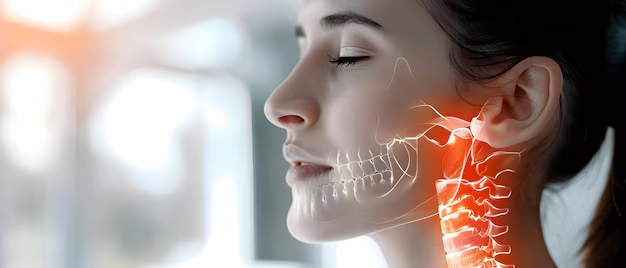
Your lower jaw, or mandible, and your skull, or temporal bone, are connected by a joint on either side of your head called the temporomandibular joint, or TMJ. It is a complicated joint that is surprisingly flexible, making it necessary for motions like chewing, speaking, and yawning.
The TMJ consists of several components:
- Bones: The mandible and temporal bone.
- Cartilage: A disc separates the bones and cushions the joint during movement.
- Ligaments: These connect the bones and stabilize the joint.
- Muscles: Numerous muscles control jaw movement, opening, closing, and side-to-side grinding.
5 Causes of TMJ
A variety of illnesses affecting the jaw joint and surrounding muscles are referred to as TMJ disorders. The exact causes can vary, but some common factors include:
- Muscle overuse or strain: This can be caused by teeth grinding (bruxism), clenching your jaw due to stress, or excessive chewing gum.
- Misalignment of the jaw can be due to a structural abnormality, injury, or arthritis.
- Disc problems: The disc within the joint can become displaced or damaged, causing pain and limited movement.
- Inflammation: Inflammation of the joint lining or surrounding tissues can contribute to pain and discomfort.
- Trauma: A blow to the face or jaw can damage the joint and surrounding structures
8 Signs & Symptoms of TMJ
The symptoms of TMJ issues can vary widely in terms of both their severity and mode of manifestation. Here are a few typical indications and symptoms:
- Pain: Pain in the jaw joint, face, ear, or temple region.
- Jaw stiffness: Having trouble fully opening or closing your mouth.
- Joint clicking or popping: Sounds heard when opening or closing your mouth.
- Locking of the jaw: Inability to open or close your mouth completely.
- Facial pain or tenderness: Pain in the cheeks, around the eyes, or headaches.
- Earaches: Pain in or around the ear canal, even though the ear might not be infected.
- Chewing difficulties: Difficulty chewing or discomfort during eating.
- Tinnitus: Ringing or buzzing sound in one or both ears.
10 Physical Therapy TMJ Exercises
Before diving into TMJ treatment exercises, remember to perform the earlier warm-up exercises (neck rolls, chin tucks, jaw side bends) to prepare your jaw and muscles for movement.
Here are ten targeted exercises that have proven effective in relieving TMJ pain:
1. Goldfish Exercise (Partial Opening):
- Benefits: Improves jaw mobility and stretches the jaw muscles.
- How-to: Place your tongue on the roof of your mouth, just behind your front teeth. Slowly open your mouth slightly, maintaining a comfortable range. Hold for 3 seconds, then close your mouth gently. Do this for at least 10x a day.
2. Goldfish Exercise (Full Opening):
- Benefits: Similar to the partial opening exercise, but with a deeper stretch.
- How-to: Follow the same steps above, but open your mouth as wide as possible without straining. Hold for 3 seconds, then close slowly. Repeat 10 times.
3. Lateral Glides:
- Benefits: Improves side-to-side jaw mobility and stretches the jaw muscles.
- How-to: Close your lips gently. Move your jaw side-to-side, feeling a slight stretch on each side. Imagine you’re trying to grind your teeth side-to-side without making contact. Repeat 10 times on each side.
4. Jaw Isometrics (Clench):
- Benefits: Strengthens jaw muscles and improves stability.
- How-to: Gently clench your teeth together for a few seconds, focusing on feeling the muscles in your jaw contract. Relax completely. Repeat 10 times.
5. Jaw Isometrics (Pout):
- Benefits: Strengthens the muscles that help open your jaw.
- How-to: Push your lower jaw slightly forward, creating a gentle pout. Hold for a few seconds, feeling the muscles under your chin contract. Relax completely. Repeat 10 times.
6. Chin Tucks with Rotation:
- Benefits: Improves posture, stretches neck muscles, and reduces tension that can contribute to TMJ pain.
- How-to: Take proper stance when standing or sitting. Feel the stretch in your neck as you slowly swivel your head to one side after tucking your chin down towards your chest and holding it there for a few seconds. After a brief period of holding, move back to the center and repeat on the opposite side. Work out five times on each side.
7. Pursed-Lip Breathing:
- Benefits: Promotes relaxation and reduces tension in the jaw muscles.
- How-to: Inhale slowly through your nose, then purse your lips as if you’re about to whistle. Exhale slowly through your pursed lips for a count of 4. Repeat 5-10 times.
8. Tongue Posture Exercise:
- Benefits: Improves posture of the tongue, which can help alleviate TMJ pain.
- How-to: Place the tip of your tongue on the roof of your mouth, just behind your upper front teeth. Rest your tongue in this position throughout the day, especially when your mouth is at rest.
9. Myofascial Release (Optional):
- Benefits: Releases trigger points in the jaw muscles that can contribute to pain.
- How-to: This can be done with a small, firm ball or your fingertips. Gently apply pressure to a tender spot in your jaw muscle and hold for 30 seconds. Release and repeat on other tender spots. Note: Use caution and avoid applying excessive pressure. If you need more clarification, consult a physical therapist for proper instruction.
10. Proprioceptive Neuromuscular Facilitation (PNF) Techniques (Advanced):
- Benefits: Improves joint awareness and proprioception (body’s sense of position).
- How-to: These techniques involve isometric holds combined with slow, assisted movements. They are most effective when performed under the guidance of a physical therapist who can tailor them to your specific needs.
Conclusion
Physical therapy exercises empower you to manage TMJ pain. Unlike medication, they target the root cause – joint and muscle dysfunction – promoting long-term relief and improved jaw function. This translates to a better quality of life, allowing you to eat, talk, and smile easily. Consistency is key. Regularly practice these exercises alongside other strategies and consult your physical therapist for a personalized approach.
While these exercises can assist in alleviating jaw pain, individuals experiencing TMJ discomfort require professional treatment for long-term relief. At Town Physical Therapy, we take pride in providing a range of treatment options to help patients experience reduced pain. Contact Town Physical Therapy today to discover more about TMJ treatment in Maywood, Emerson, Bergenfield, Clifton and Paramus.
About the Author: Town PT