Physical Therapy vs. Chiropractic Care in Clifton — Which Is Right for You?
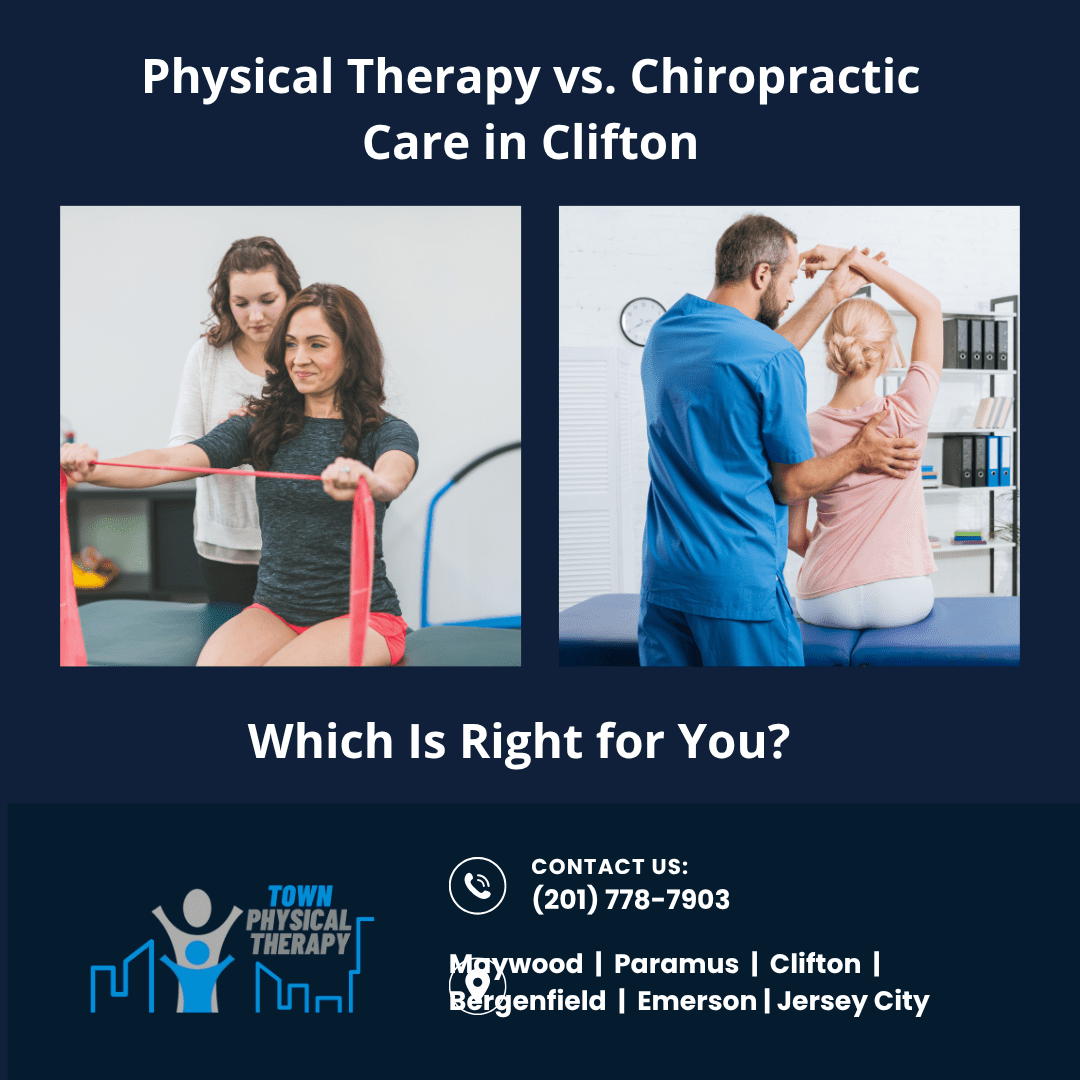
You’re in pain. You’ve heard physical therapy can help. You’ve also heard chiropractic care works wonders. Both are non-surgical, drug-free options — so how do you choose? The answer depends on your condition, your goals, and how your body responds to treatment.
At Town Physical Therapy in Clifton, NJ, we get this question all the time. This guide lays out the real differences between physical therapy and chiropractic care so you can walk into the right office with confidence.
What Is Physical Therapy?
Physical therapy (PT) is a healthcare specialty focused on restoring movement, rebuilding strength, and improving function. At its core, PT is about fixing the root cause of your pain — not just the symptom.
Licensed physical therapists (DPTs) assess your posture, range of motion, strength imbalances, and movement patterns. From there, they design a personalized treatment plan that typically includes:
- Therapeutic exercises — targeted movements to rebuild strength and stability
- Manual therapy — hands-on techniques to improve joint and soft tissue mobility
- Dry needling — releasing tight muscle bands to reduce pain and improve movement
- EPAT / shockwave therapy — technology-assisted treatment for chronic pain
- Postural and movement re-education — correcting the habits driving your pain
The goal of PT isn’t just to get you out of pain today — it’s to build the strength and resilience so the pain doesn’t come back next month.
Town PT Clifton offers
Sports rehab, dry needling, EPAT, manual therapy, cupping, occupational therapy, pediatric PT, and more — all under one roof at our Clifton, NJ location.
What Is Chiropractic Care?
Chiropractic care focuses primarily on the spine and the relationship between spinal alignment and the nervous system. Chiropractors use hands-on spinal manipulation — often called adjustments — to correct misalignments (subluxations) that may be causing pain or restricting movement.
A typical chiropractic visit involves:
- Spinal adjustments — quick, controlled force applied to specific joints
- Soft tissue therapy — some chiropractors also address muscles and tendons
- Lifestyle and nutritional advice — depending on the practitioner
Chiropractic care can provide fast relief — especially for spinal misalignment and acute pain. However, adjustments alone don’t rebuild the muscle strength and movement patterns needed for lasting recovery.
| Factor | Physical Therapy | Chiropractic Care |
|---|---|---|
| Primary focus | Movement, strength, function | Spinal alignment, nervous system |
| Main technique | Exercise, manual therapy, modalities | Spinal adjustments |
| Duration of care | Defined plan with clear endpoints | Ongoing maintenance common |
| Post-surgical rehab | ✓ Standard of care | Not typically recommended |
| Sports injury recovery | ✓ Highly effective | Partial (spine-related only) |
| Muscle strengthening | ✓ Core component | Limited |
| Fast pain relief | Varies by condition | ✓ Often immediate |
| Long-term results | ✓ Addresses root cause | May require ongoing visits |
| Insurance coverage in NJ | ✓ Most plans cover PT | Varies by plan |
Which One Is Right for You?
Here’s the straightforward answer most providers won’t give you:
If your goal is long-term recovery — physical therapy is almost always the better choice. PT addresses the underlying muscle imbalances, movement dysfunctions, and weaknesses that cause pain to keep coming back. You graduate from PT with a body that’s stronger and more resilient than before your injury.
If you need fast relief from acute spinal pain — chiropractic care may provide quick symptom relief. Some patients do best with both, using chiropractic for immediate pain reduction and PT for long-term rehabilitation.
Choose Physical Therapy if you…
- Are recovering from surgery
- Have a sports or overuse injury
- Want to strengthen, not just align
- Have been dealing with pain for months
- Need a structured recovery timeline
- Want to prevent future injury
- Are recovering from a car accident
Consider Chiropractic if you…
- Have acute spinal misalignment
- Want fast relief for a recent flare-up
- Have been diagnosed with subluxation
- Prefer maintenance-based wellness care
Conditions Treated by Each
Conditions Physical Therapy excels at treating:
- Lower back pain and sciatica
- Rotator cuff tears and shoulder impingement
- ACL, meniscus, and knee injuries
- Plantar fasciitis and Achilles tendinopathy
- Post-surgical rehabilitation (hip replacement, knee replacement, spinal surgery)
- TMJ dysfunction
- Neck pain and cervicogenic headaches
- Sports injuries — from weekend warriors to competitive athletes
- Work-related injuries
- Pediatric movement disorders
Conditions chiropractic care is commonly used for:
- Spinal misalignment and subluxation
- Acute low back pain
- Tension headaches related to the cervical spine
- General spinal maintenance
Notice the overlap — conditions like low back pain and neck pain appear on both lists. For these, the evidence strongly favors physical therapy for lasting improvement, while chiropractic care may help manage acute flare-ups.
Frequently Asked Questions
1. Is physical therapy better than chiropractic care for back pain?
2. Can I do both physical therapy and chiropractic care?
3. Do I need a referral for physical therapy in New Jersey?
4. How long does physical therapy take?
5. Is Town PT currently accepting new patients in Clifton, NJ?
Why Clifton Patients Choose Town Physical Therapy
Town PT has been serving New Jersey families across six locations — including Clifton — with one-on-one, evidence-based physical therapy. Here’s what sets us apart:
- One-on-one care — you work directly with your therapist every visit, not an aide
- Full spectrum of services — dry needling, EPAT, cupping, manual therapy, occupational therapy, and pediatric PT
- Insurance accepted — most major plans, including Horizon BCBS, Aetna, Cigna, and Medicare
- Same-week appointments — don’t wait weeks to start feeling better
- 5-star rated — real results backed by real patient reviews
- Serving all of Bergen and Passaic County — with locations in Clifton, Paramus, Maywood, Emerson, Bergenfield, and Jersey City
About the Author: Town PT