Sciatica vs. Lower Back Pain — How to Tell the Difference and What to Do
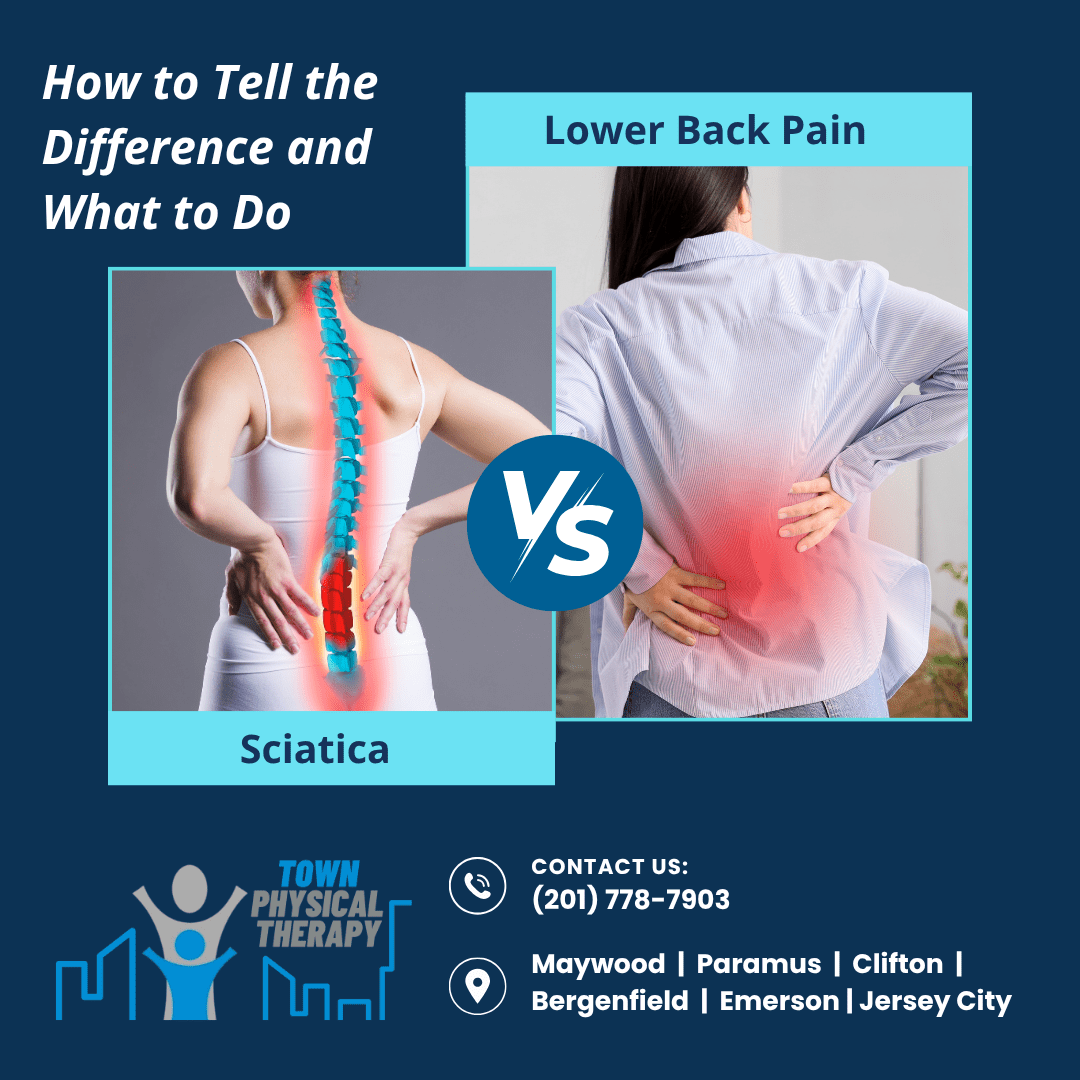
Lower back pain is one of the most common reasons people see a physical therapist — but not all back pain is the same. Sciatica is a specific type of nerve pain, while general lower back pain usually comes from muscles, ligaments, or joints. Knowing the difference changes how it should be treated.
At Town Physical Therapy, we evaluate dozens of patients every week with one simple question: “Is this sciatica, or just my back?” Here’s how we tell the difference — and what we’d recommend if it were you.
What’s the Real Difference?
The simplest way to think about it: lower back pain stays in your back. Sciatica travels.
Sciatica refers to pain caused by irritation or compression of the sciatic nerve — the longest nerve in your body, running from your lower spine through your hip and down each leg. When something presses on or irritates this nerve, you feel pain not just in your back, but radiating down your leg.
Regular lower back pain, on the other hand, is usually mechanical — coming from strained muscles, irritated joints, or ligament sprains in the lumbar spine. It can be intense, but it typically doesn’t travel past the buttock.
What Is Sciatica?
Sciatica isn’t a diagnosis on its own — it’s a symptom of an underlying issue compressing the sciatic nerve. Common symptoms include:
- Sharp, shooting, or burning pain down one leg
- Pain that worsens when sitting
- Numbness or tingling in the leg or foot
- Muscle weakness in the leg or foot
- Pain that radiates from the lower back through the buttock and down the back of the thigh
- Usually affects only one side of the body
Sciatica pain can range from a mild ache to a sharp, electric-shock sensation that makes it difficult to stand, walk, or sit for long periods.
What Is Regular Lower Back Pain?
Mechanical lower back pain stays localized and usually stems from muscle strain, joint irritation, or poor movement patterns. Common symptoms include:
- Dull, aching, or stiff pain in the lower back
- Pain that worsens with certain movements (bending, twisting, lifting)
- Muscle tightness or spasm
- Pain that improves with rest or position changes
- No numbness or tingling down the leg
- Often affects both sides of the lower back
Symptom Checklist: Which One Do You Have?
| Symptom | Sciatica | Lower Back Pain |
|---|---|---|
| Pain location | Radiates down one leg | Stays in the lower back |
| Numbness or tingling | Common, in leg or foot | Rare |
| Affected side | Usually one-sided | Often both sides |
| Worsens when sitting | Often yes | Sometimes |
| Triggered by movement | Sometimes | Almost always (bending, lifting) |
| Muscle weakness | Possible, in the leg | Rare |
| Pain quality | Sharp, shooting, burning | Dull, aching, tight |
What Causes Each Condition?
Common causes of sciatica:
- Herniated or bulging disc pressing on the sciatic nerve
- Spinal stenosis (narrowing of the spinal canal)
- Piriformis syndrome (a tight muscle compressing the nerve)
- Degenerative disc disease
- Spondylolisthesis (a vertebra slipping out of place)
Common causes of mechanical lower back pain:
- Muscle strain from lifting, twisting, or overuse
- Poor posture, especially from prolonged sitting
- Weak core or hip muscles
- Sudden movements or awkward sleeping positions
- General wear and tear on the spine over time
When to Seek Care Immediately
Loss of bladder or bowel control, numbness in the groin/inner thigh area, or progressive weakness in both legs. These can be signs of a rare but serious condition called cauda equina syndrome and require immediate emergency attention.
For most other cases of sciatica or back pain, you don’t need to rush to the ER — but you also shouldn’t wait it out indefinitely. If pain lasts more than a few days, or limits your daily activities, it’s time to get evaluated.
Book an Appointment
How Physical Therapy Treats Each Condition
The good news: both sciatica and mechanical lower back pain respond extremely well to physical therapy — but the approach differs.
For sciatica, treatment typically includes:
- Nerve gliding exercises — gentle movements to reduce nerve irritation
- Directional preference exercises — movements that relieve disc-related pressure on the nerve
- Manual therapy — to relieve muscle tension around the compressed nerve
- Dry needling — particularly effective for piriformis-related sciatica
- Core and hip strengthening — to reduce strain on the lower spine long-term
For mechanical lower back pain, treatment typically includes:
- Manual therapy — to restore joint mobility and reduce muscle guarding
- Core stabilization exercises — to support the lumbar spine
- Postural retraining — especially for desk workers
- Progressive strengthening — to build resilience and prevent recurrence
Frequently Asked Questions
1. How do I know if my back pain is sciatica?
2. Can physical therapy fix sciatica?
3. How long does sciatica take to heal?
4. Do I need a referral to see a physical therapist in NJ?
5. When should I see a doctor instead of a physical therapist?
How Town Physical Therapy Can Help
Whether you’re dealing with sciatica or general lower back pain, the team at Town PT starts every case with a thorough evaluation to identify the actual source of your pain — not just the symptoms. From there, we build a plan designed around your specific diagnosis, lifestyle, and goals.
- One-on-one care — your therapist treats you directly, every visit
- Dry needling and manual therapy — for fast, targeted relief
- Custom strengthening programs — to keep the pain from returning
- Most major insurances accepted — including Horizon BCBS, Aetna, Cigna, and Medicare
- Six convenient NJ locations — Clifton, Paramus, Maywood, Emerson, Bergenfield, and Jersey City
Don’t Wait for the Pain to Get Worse
Whether it’s sciatica or just a stubborn ache, our team can help you figure out exactly what’s going on — and how to fix it.
Book an Appointment
About the Author: Town PT