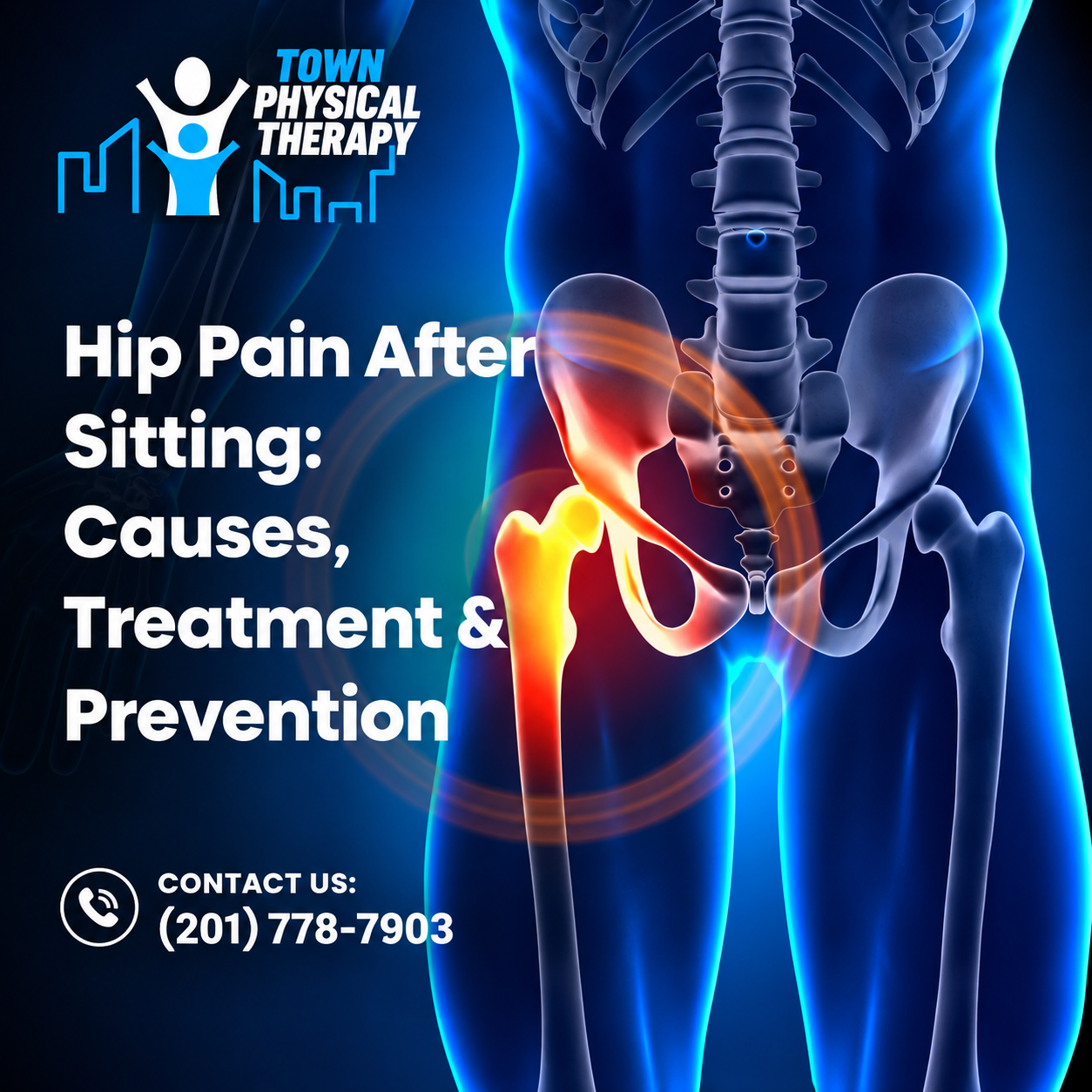
Hip Pain After Sitting: Causes, Treatment & Prevention
You get up from your desk, the car, or the couch, and your hip is stiff, achy, or sore. It takes a few steps to loosen up, or maybe the pain lingers all day. If this sounds familiar, you are not alone. Hip pain after sitting is one of the most common complaints we hear, especially from people with desk jobs, long commutes, or busy family lives.
Sitting itself is not “bad,” but staying in one position for a long time can tighten some muscles, switch others off, and put steady pressure on the hip joint. The good news is that most cases of hip pain after sitting can be improved with the right movement, a few setup changes, and, when needed, physical therapy.
This guide covers the most common causes, simple ways to get relief, how to prevent the pain from coming back, and when to get help.
Quick answer: Hip pain after sitting is most often caused by tight hip flexors, weak glute muscles, hip arthritis, bursitis, a pinched or irritated nerve, or a joint problem such as hip impingement. Changing positions often, walking, gentle stretching, and strengthening the hips can help. If pain is severe, constant, or comes with numbness or weakness, get it checked.
Why Does My Hip Hurt After Sitting?
Several things can happen to your hips when you sit for long periods.
- The hip flexors stay shortened. When you sit, your hips are bent, and the muscles at the front of the hip stay in a shortened position. Over time they can tighten and pull on the pelvis and lower back when you stand.
- The glutes switch off. Sitting on your glute muscles for hours can leave them weak and slow to activate. When the glutes do not do their job, other muscles and joints take on extra stress.
- The joint gets stiff. Joints like to move. Staying still lets them stiffen, and cartilage and tissues get less of the movement that keeps them healthy.
- Pressure builds up. Sitting on a hard surface or leaning to one side can irritate tendons, bursae, and nerves around the hip.
- Posture changes the load. Slouching, crossing your legs, or sitting on a wallet can tilt your pelvis and twist the hip.
Common Causes of Hip Pain After Sitting
1. Tight hip flexors
Pain or tightness at the front of the hip or groin when you stand up, often with a “stuck” feeling in the lower back, can point to tight hip flexor muscles. This is very common in people who sit most of the day.
2. Weak glutes and hip muscles
If the glutes are weak, the hip joint and nearby muscles have to work harder. This can cause an ache on the side or back of the hip. Strengthening these muscles is often a key part of treatment. See our guide on how to improve hip mobility for related exercises.
3. Hip bursitis and gluteal tendon irritation
Pain on the outside of the hip, often tender to the touch and sore when lying on that side or sitting on a hard surface, may be trochanteric bursitis or irritation of the gluteal tendons. It can also hurt when you get up from a chair or climb stairs. A related condition is iliopsoas bursitis, which causes pain at the front of the hip.
4. Hip osteoarthritis
Stiffness and aching in the hip or groin after sitting, which eases once you start moving, is a typical sign of hip arthritis. It often gets worse in the morning or after long rest. Learn more about arthritis care and how physical therapy can help manage symptoms.
5. Hip impingement (FAI) and labral problems
If you feel a pinch at the front of the hip when you sit in a low seat, bring your knee toward your chest, or put on shoes, the hip joint may be impinging. In some people, the cartilage rim of the hip socket (the labrum) is also irritated. Clicking, catching, or deep groin pain can go along with it.
6. Piriformis and deep gluteal pain
Pain deep in the buttock that worsens with sitting, especially on a hard seat, may involve the piriformis muscle or other deep hip rotators. These muscles sit close to the sciatic nerve and can irritate it, causing pain that travels down the leg. See our overview of sciatica, and if you are unsure whether your pain starts in the back or the hip, read Sciatica vs Lower Back Pain: How to Tell the Difference.
7. Sacroiliac (SI) joint pain
The SI joints connect the base of your spine to your pelvis. When they are irritated, you may feel pain in the lower back, buttock, or hip, especially when going from sitting to standing. Learn more about SI joint pain.
8. Lower back problems
Sometimes the hip is not the source at all. A stiff or irritated lower back, a disc issue, or a pinched nerve can refer pain into the hip and buttock. Our back pain page explains the common causes.
9. Proximal hamstring tendon irritation
Pain right under the buttock where the hamstring attaches to the sitting bone, which is worst when you sit on firm surfaces, can be a hamstring tendon problem. See hamstring strain or tear for related information.
10. Other contributors
Pregnancy and postpartum changes, an old injury, running or cycling overload, and leg-length differences can also play a part. For women’s specific concerns, see our women’s health services and pelvic floor rehabilitation.
When Hip Pain Needs Medical Attention
Seek prompt medical care if you have:
- Sudden, severe hip pain after a fall or injury
- Inability to put weight on the leg
- Hip pain with fever, redness, warmth, or swelling
- Numbness in the groin or inner thighs, or new bladder or bowel changes. Go to the ER right away.
- Calf pain, swelling, or warmth in one leg after long travel or sitting, which can signal a blood clot
- Constant night pain that does not ease with any position
- Unexplained weight loss together with hip or back pain
How to Relieve Hip Pain After Sitting
These steps can often ease symptoms. If they do not help in a week or two, get an evaluation.
Move more often
Aim to stand, walk, or change position about every 30 minutes. Even a one-minute break to stand and walk to refill your water helps.
Try these gentle stretches and exercises
Kneeling hip flexor stretch. Kneel on one knee (use a cushion), keep your torso upright, tuck your tailbone slightly, and shift forward until you feel a stretch at the front of the back leg’s hip. Hold 30 seconds, 2 to 3 times per side.
Figure-4 stretch. Lie on your back, cross one ankle over the opposite knee, and gently pull the bottom thigh toward you until you feel a stretch in the buttock. Hold 30 seconds, 2 to 3 times per side.
Glute bridge. Lie on your back with knees bent. Squeeze your glutes and lift your hips, hold 2 seconds, then lower slowly. Do 2 to 3 sets of 10 to 12.
Clamshells. Lie on your side with knees bent and feet together. Keeping your feet touching, lift the top knee, then lower slowly. Do 2 to 3 sets of 10 to 15 per side.
Standing hip extension. Hold a counter, keep your torso still, and move one leg straight back, squeezing the glute. Do 2 sets of 10 per side.
For more ideas, see our standing mobility exercises. Stop any exercise that causes sharp or worsening pain.
Use heat or ice
Heat can relax stiff muscles before you exercise. Ice may help with a sore, irritated spot after activity. Use whichever feels better, for 10 to 15 minutes at a time, with a cloth between the pack and your skin.
Take pressure off the sore spot
If the outside of the hip or the buttock is sore, avoid sitting on hard surfaces or leaning on one side. Use a cushion, and avoid sleeping on the painful side. A pillow between your knees can help.
Set Up Your Seat to Protect Your Hips
Small changes at your desk or in your car can make a big difference.
- Keep your hips at or slightly above knee level. A seat that is too low increases hip bend and impingement.
- Place feet flat on the floor or a footrest.
- Sit back in the chair with lumbar support so you do not slump.
- Do not cross your legs for long periods, and avoid sitting on a thick wallet.
- Share your weight evenly on both sit bones.
- Use a sit-stand desk if you can, and alternate positions during the day.
- Adjust your car seat so your knees are not higher than your hips, and take breaks on long drives.
For more on how posture affects pain, read Posture Correction: How Physical Therapy Can Improve Your Alignment and our postural re-education page. If your pain is tied to your job, ask about our workers’ compensation program.
How Physical Therapy Treats Hip Pain After Sitting
Because many different problems can cause this pain, treatment starts with finding the real cause. Your therapist will look at how your hip, pelvis, and lower back move, test your strength and flexibility, and watch how you sit, stand, and walk. Your plan may include:
- Physical therapy and rehabilitation: A personal program to stretch tight muscles, strengthen the glutes and core, and improve how your hips move.
- Soft tissue mobilization: Hands-on techniques to ease tight muscles and tendons around the hip.
- Chiropractic care and flexion-distraction therapy: May help when the lower back or SI joint is part of the picture.
- Acupuncture and dry needling: Can help calm painful, tight muscles in suitable cases.
- Shockwave therapy: A non-invasive option that may help stubborn tendon pain around the hip.
- Posture and movement training: Practical tips for your desk, car, and daily routine.
If you have already had hip surgery, read PT After Hip Replacement: Walk Without Pain. To explore everything we offer for this area, visit our hip and groin pain page. Not sure what to expect? Read First Time Physical Therapy? Here’s What to Expect.
How to Prevent Hip Pain from Sitting
- Break up sitting time. Stand, walk, or stretch every 30 minutes.
- Strengthen your hips and core 2 to 3 times a week. Strong glutes protect your hips.
- Stay active. Regular walking, swimming, or cycling keeps joints moving.
- Keep a healthy weight, which reduces stress on the hip joints.
- Warm up before exercise and increase intensity gradually.
- Choose supportive seating at work, at home, and in the car.
- Listen to early signals. Mild stiffness that keeps coming back is a cue to act early.
Frequently Asked Questions
Why do my hips hurt when I sit for a long time?
Long sitting keeps the hip flexors shortened, can weaken the glutes, and puts steady pressure on the joint and tendons. Over time this can lead to stiffness and pain, especially if you already have arthritis, bursitis, or a joint problem.
Why does my hip hurt when I stand up after sitting?
Stiffness and “start-up” pain are common with hip arthritis and tight muscles. The joint and muscles have been still, and they need a moment to warm up. If the pain is sharp, grows worse, or does not ease after a few steps, get it checked.
Can sitting cause sciatica or hip pain?
Sitting can irritate the sciatic nerve in some people, especially when deep hip muscles are tight or the lower back is stressed. This can cause buttock and leg pain.
Is walking good for hip pain?
For most people, yes. Gentle walking improves circulation and keeps the joint moving. If walking makes the pain much worse, reduce the distance and get an evaluation.
What is the best sitting position for hip pain?
Sit with your hips slightly higher than your knees, feet flat, and weight even on both sit bones, with your back supported. The best position is also the next one: change positions often.
How long does it take for hip pain to go away?
It depends on the cause. Mild muscle-related pain can improve in a few weeks with the right exercises. Joint-related causes like arthritis can take longer and are managed over time.
When should I see a physical therapist for hip pain?
If your pain lasts more than a week or two, keeps returning, limits daily activities, or comes with weakness, clicking, or pain in the groin or leg, an evaluation is a good idea.
Get Relief for Hip Pain at a Town Physical Therapy Location Near You
You do not have to build your day around hip pain. Our therapists treat hip, back, and related pain at clinics across New Jersey. Find the closest office on our clinic locations page, including Paramus, Clifton, Bergenfield, Jersey City, and more.
Request an appointment and get a plan built for your hips.
About the Author: Town PT